You open Meta Ads Manager and your CTR looks healthy. Clicks are coming in. But the conversions are not there. This is one of the most common and costly situations in digital advertising, and it almost never has one single cause.
After managing paid media campaigns for 95+ businesses across B2B, eCommerce, and local services, the team at Infinite Ville has diagnosed this problem hundreds of times. The seven reasons below cover the issues that account for the vast majority of conversion failures we see. Each one has a clear, actionable fix.
- 97% of first time visitors do not convert on their first visit.
Source: Meta Advertising Research, 2025. This makes retargeting infrastructure not optional but structurally necessary for any campaign expecting profitable ROAS. Most businesses allocate less than 10% of their Meta budget to retargeting. The highest performing accounts we manage allocate 25 to 40 percent.
- Running Facebook ads and not seeing the conversions you expected?
Infinite Ville audits Meta ad accounts and identifies the specific reasons campaigns underperform. We fix tracking gaps, rebuild campaign structure, and optimize creative. You get a clear picture of what is wrong before any work begins.
Book Your Free Meta Ads Audit at Click Here
Reason 01: Broken or Incomplete Conversion Tracking
This is the most impactful issue and the most commonly overlooked. If Meta does not see your conversions, its algorithm cannot optimise toward them. It keeps spending your budget reaching people who will never buy, because it has no data telling it what a buyer looks like.
The browser based Meta Pixel alone is no longer sufficient. Since Apple introduced App Tracking Transparency with iOS 14.5, a large share of iPhone users opt out of tracking by default. When someone clicks your ad on an iPhone, converts on your site, and the Pixel never fires, Meta records that click as a bounce. Every missed conversion is a learning signal the algorithm never receives.
Ad blockers compound the problem. Roughly 25 to 30% of internet users run some form of ad blocking software, and these tools block tracking pixels too. According to analysis from Cometly (March 2026), businesses frequently see 30 to 40% fewer conversions in Meta Ads Manager than in their CRM or payment processor. That gap represents lost optimization data.

- THE FIX
Install the Conversions API (CAPI) alongside the browser Pixel. CAPI sends conversion data server-side, bypassing browser restrictions entirely. Use Meta’s Events Manager Test Events tool to confirm purchase events fire correctly with the right value passed. Enable deduplication so browser and server events do not double count. If you are on Shopify, WooCommerce, or a major eCommerce platform, Meta’s native CAPI integrations handle this without custom code.
Reason 02: The Campaign Objective Does Not Match Your Actual Goal
Meta optimises your budget toward the goal you tell it to optimise for. If you select Traffic as your campaign objective because you want people to visit your site, Meta finds people who click links. Not people who buy things. These are two different audiences with different behaviours, and Meta builds them separately.
Many businesses run Engagement campaigns hoping for sales, or Traffic campaigns hoping for leads. The algorithm delivers what you asked for. It is not making a mistake. You are asking for the wrong thing.
- THE FIX
Match your campaign objective to your actual business goal. If you want purchases, select Sales. If you want form submissions, select Leads. If your account does not yet generate 30 or more purchase events per week, optimizing for Purchase puts your campaigns into learning limited status permanently. In that case, optimize for an earlier funnel event such as Add to Cart or Landing Page View until your purchase volume grows. Once you hit 50 conversion events per ad set per week, migrate back to Purchase optimization.
Reason 03: Your Audience Targeting Is Too Broad or Misaligned
Interest based targeting on Meta has weakened significantly since iOS 14 reduced the accuracy of third-party behavioral data. Broad interest audiences that once reliably delivered qualified buyers now include large proportions of people who will never purchase, regardless of how relevant the creative is.
Cold audiences built on generic interests also lack the purchase intent signals that make ads efficient. Someone who follows a fitness page on Facebook is not necessarily in-market for fitness equipment right now. Meta’s algorithm can find that person, but it cannot manufacture intent that does not exist.
- THE FIX
Shift your prospecting strategy toward first party data and signals Meta can actually verify. Upload your existing customer list as a Custom Audience and use it to build a Lookalike Audience at 1 to 2% similarity. This gives Meta real behavioral signals from people who have already bought from you. Layer Advantage Plus Audience on top, which allows Meta’s AI to expand beyond your defined parameters when it identifies high conversion probability users. For B2B advertisers, combine interest targeting with job title and industry filters to add intent context.
Reason 04: Creative Fatigue Is Killing Performance
Ad fatigue occurs when the same audience sees the same creative too many times. Familiarity kills curiosity. Once users recognize your ad, they stop engaging with it. Meta’s frequency metric, which measures how many times the average person in your audience has seen a given ad, is the clearest signal that fatigue has set in.
When frequency exceeds 3 within a 7-day window for cold audiences, click through rates typically fall and cost per acquisition rises. Many advertisers leave fatigued creative running because it produced good results previously, not realizing those results are now funding an audience that has already decided not to buy.
- THE FIX
Monitor frequency at the ad set level and set a refresh trigger: when 7-day frequency exceeds 3, introduce new creative. You do not need to rebuild the entire ad. Change the hook, swap the visual format from static to video or video to carousel, or introduce user generated content alongside polished creative. The goal is to signal to an audience that already knows your brand that something new is worth their attention. For warm and retargeting audiences, run creative on rotation with frequency caps enabled to prevent any single variant from dominating.
How to Get More Followers on TikTok
Reason 05: The Landing Page Breaks the Promise the Ad Made
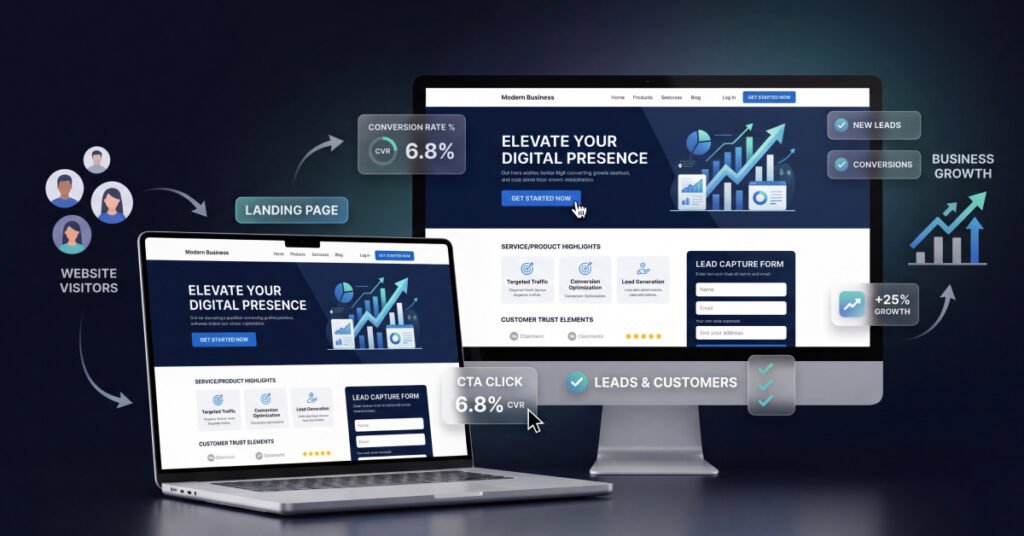
Your ad generates a click because it makes a specific promise: a particular offer, a solution to a named problem, a specific benefit. The visitor clicks expecting to find exactly what you described. If your landing page opens with a different headline, a generic brand message, or no visible reference to the offer from the ad, the conversion dies in the first three seconds.
This is message mismatch, and it is the most common post click conversion killer. Most advertisers diagnose it as a creative problem and keep testing new ads, when the issue is the page those ads send traffic to. The ad did its job. The landing page did not.
- THE FIX
Match your landing page headline directly to your ad headline. If your ad says ‘Get 30% off your first order,’ your landing page should open with the same offer in the same language. Remove navigation menus that give visitors routes away from the conversion point. Reduce form fields to the minimum required. Add trust signals including reviews, security badges, and guarantees near the conversion point. Test your page load speed on mobile in Google Page Speed Insights. If it takes more than two seconds to load, you are losing a significant proportion of your clicks before the page even renders. Most Facebook traffic comes from mobile devices, and mobile users abandon slow pages at a rate desktop users do not.
Reason 06: Insufficient Budget for the Algorithm to Learn
Meta’s machine learning needs data to optimize. Specifically, it needs a minimum of 50 conversion events per ad set per week to exit the learning phase and begin optimizing effectively. Below that threshold, your campaign runs in learning limited status, which means the algorithm is still guessing rather than identifying patterns. Performance is inconsistent and costs stay higher than they should.
Many businesses spread budgets too thin across too many ad sets, meaning none of them generate enough conversion events to teach Meta anything useful. Ten ad sets at 50 dollars per day each produce fragmented learning. Three ad sets at 160 dollars per day each produce enough signal to learn quickly and optimize effectively.
- THE FIX
Consolidate your campaign structure. Fewer ad sets with higher budgets exit the learning phase faster and produce more stable performance. If your budget does not allow 50 purchases per ad set per week, optimize for a higher volume earlier funnel event and let the algorithm learn from that. Use Campaign Budget Optimization (CBO) to let Meta distribute budget dynamically across ad sets based on real time performance signals rather than fixed allocations. Avoid editing active ad sets. Every significant edit (new creative, audience change, budget increase above 20%) resets the learning phase and throws away accumulated data.
Reason 07: No Retargeting Strategy for Unconverted Traffic
Ninety seven percent of first time visitors do not convert. They click your ad, land on your page, leave without buying, and if you have no retargeting in place, they are gone. You paid for that click and received nothing from it. A retargeting funnel turns that sunk cost into a second, third, and fourth conversion opportunity.
Retargeting audiences segment your unconverted traffic by behavior: people who visited your site, people who viewed a specific product, people who added to cart but did not purchase. Each segment needs different creative because they are at different stages of the decision process. Showing a cold-audience awareness ad to someone who already added to cart wastes their attention and your budget.
- THE FIX
Build a three layer retargeting funnel. Layer one targets site visitors who did not view a product, and shows them educational or social proof content. Layer two targets product viewers and cart abandoners with the specific product they engaged with, paired with a reason to act now such as limited stock, a discount, or a testimonial from a customer who made the same choice. Layer three targets checkout abandoners with the strongest possible offer and the least possible friction. Exclude converted customers from all retargeting layers to stop spending on people who already bought. Refresh retargeting creative every two weeks because these audiences are smaller and reach frequency faster than cold audiences.
Know Which of These Seven Reasons is Costing You the Most?
- Infinite Ville audits Meta ad accounts and delivers a prioritized fix list showing exactly which issues are suppressing your conversions and in what order to address them. We have managed paid media for 95+ businesses and know what profitable account structure looks like.
Book Your Free Meta Ads Review at infiniteville.com/
How to Diagnose Your Specific Conversion Problem
Before making any changes, confirm which stage of your funnel is actually breaking down. Meta Ads Manager shows you each stage separately when you know where to look.
- Check your CTR. Industry average for Facebook feed ads is 0.9 to 1.5%. A CTR below 0.5% means your creative is not compelling enough to generate a click. The problem is at the impression to click stage.
- Check Landing Page Views versus Link Clicks. If you have 200 link clicks and 60 landing page views, you are losing 70% of your traffic before they see your offer. This points to a page load speed issue.
- Check your conversion rate from landing page views. A rate below 1% for cold traffic typically points to message mismatch, trust issues, or a friction heavy conversion process.
- Check your frequency metric. Above 3 within 7 days for cold audiences signals creative fatigue.
- Check your campaign learning status. Learning Limited means the algorithm does not have enough data. Consolidate budget or change your optimization event.
Fix the stage with the largest percentage drop off first. A 70% click to page-view loss is more valuable to fix than a 1% CTR improvement on the ad itself.
The Pattern Behind Every Failing Meta Campaign
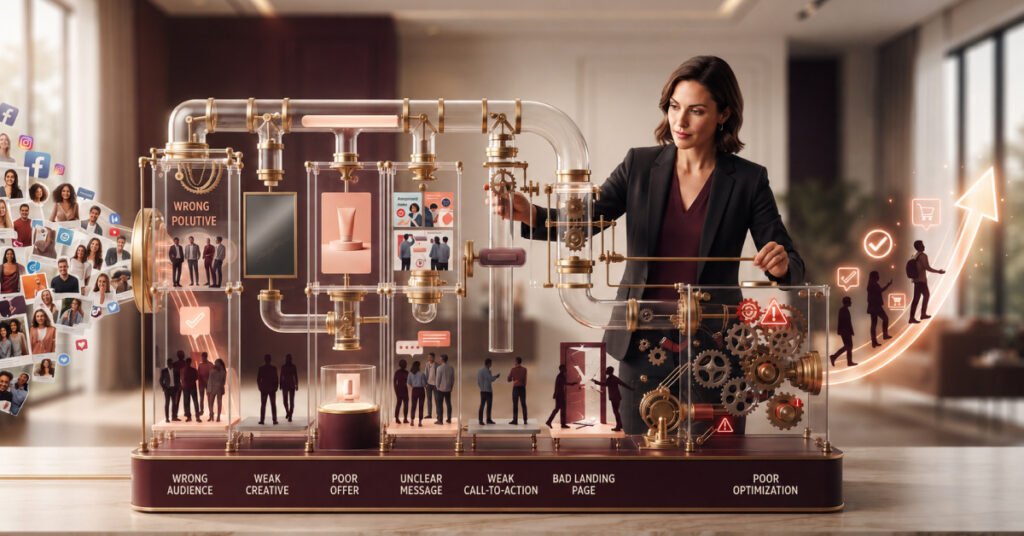
Conversion failures on Meta rarely have a single cause. They compound. Broken tracking means the algorithm learns from flawed data. Flawed learning leads to poor audience quality. Poor audience quality sends unqualified traffic to a landing page that was not built to convert them anyway. Each problem amplifies the others.
The fix is systematic, not creative. Start with tracking. Confirm your conversion data is clean before changing anything else. Then audit your campaign objective, consolidate your ad set structure, and build a retargeting layer. Creative is the last thing to test, not the first. Most accounts we audit have perfectly good creative being shown to the wrong audience with broken tracking underneath it.
Profitable Meta advertising is an engineering problem. The inputs are tracking quality, audience relevance, funnel alignment, and creative freshness. When all four work together, the algorithm rewards you with efficiency that compounds over time.
-
Ready to Turn Your Meta Ad Spend Into Predictable Revenue?
Infinite Ville builds and manages Meta ad campaigns for B2B, eCommerce, and local service businesses. We audit your current account, fix what is broken, and rebuild campaigns around a structure that actually learns and scales. The audit is free.
Book Your Free Meta Ads Audit at info@infiniteville.com
Frequently Asked Questions
Why do my Facebook ads get clicks but no sales?
Click to sale drop off usually comes from one of three places: message mismatch between your ad and landing page, a landing page experience that creates friction or lacks trust signals, or tracking gaps that prevent Meta from seeing your conversions and optimising toward buyers. Check your landing page load speed, verify your Pixel and CAPI are firing correctly, and compare your ad headline to your landing page headline. If they do not reinforce the same promise, that disconnect is likely killing conversions before they complete.
What is ad frequency and when should I be concerned?
Ad frequency measures how many times the average person in your target audience has seen a specific ad within a defined time window. When frequency exceeds 3 within 7 days for cold audiences, creative fatigue typically sets in.
Should I use broad targeting or specific interest targeting on Facebook?
The answer depends on your budget and conversion data volume. Specific interest targeting narrows your audience to people with surface level behavioral signals, but it also restricts the algorithm’s ability to find high value buyers it would have found on its own.
How often should I refresh Facebook ad creative?
For cold audiences, refresh creative when your 7-day frequency exceeds 3 or when CTR drops more than 30% from its peak. Do not wait for performance to collapse. Introduce new hooks, formats, and visual treatments proactively.
What is retargeting and why does every Meta campaign need it?
Retargeting serves ads specifically to people who have previously interacted with your brand, including website visitors, product viewers, and cart abandoners, but did not convert. Since 97% of first-time visitors leave without buying, retargeting is the mechanism that recaptures the majority of your paid traffic.