
The average advertiser running a Google Ads campaign in 2026 is doing so in an environment that looks almost nothing like it did five years ago. Performance Max has replaced individual campaign types as the default. Smart Bidding handles bid decisions in real time using machine learning signals no human could process manually.
The problem is that “set up correctly” is doing enormous amounts of work in that sentence. The same automation that accelerates a well structured campaign destroys an ill structured one, because it optimizes toward the signals you give it. Give it the wrong signals poor conversion tracking, vague audience data, mismatched landing pages, undifferentiated assets and the algorithm will work very efficiently at the wrong objective.
This guide covers what actually moves the needle on PPC performance in 2026: the foundational elements that determine campaign health, the specific levers that produce measurable improvements, and the mistakes that drain budget while looking like normal operation.
1. Quality Score: The Foundation Everything Else Builds On
Before any conversation about bidding strategy, campaign type, or audience targeting, there is Quality Score and most advertisers either ignore it or misunderstand it.
Quality Score is Google’s 1–10 rating of how relevant and useful your ad is to the person searching. It is determined by three components:
- Expected click through rate (CTR): How likely Google predicts your ad will be clicked, given the search query
- Ad Relevance: How closely your ad copy matches the intent behind the keyword
- Landing Page Experience: How useful and relevant your landing page is to someone who clicks your ad
These three components are rated as Above Average, Average, or Below Average. Landing page experience and expected CTR are weighted slightly higher than ad relevance in the final calculation.
2. Keyword Strategy: Stop Paying for Searches You Don’t Want
Most Google Ads accounts have a keyword problem. Either they’re using match types that are too broad and paying for irrelevant traffic, or they’re using match types that are too narrow and missing profitable searches. The majority have both issues simultaneously in different parts of their account.
Build negative keyword lists proactively, not reactively. Before a campaign launches, brainstorm the searches your keywords might match that you don’t want: competitor names if you’re not running competitor campaigns, geographic variants outside your service area, informational queries from people who aren’t buyers yet. Add these at account level or campaign level so they apply everywhere they’re relevant.

Match keyword intent to campaign purpose. High intent keywords (“hire PPC agency Indianapolis,” “Google Ads management services”) belong in campaigns optimized for conversion. Lower-intent, research phase keywords (“what is a good ROAS for Google Ads,” “how to improve PPC performance”) can support content marketing and top-of-funnel awareness but running them in the same campaign as conversion focused keywords distorts your data and confuses bidding algorithms.
SEO vs Google Ads: Which One Should You Choose
3. Smart Bidding: Using Automation Without Losing Control
Smart Bidding is Google’s automated bid management system, using machine learning to set bids in real time based on hundreds of signals: device, location, time, audience, search query, browser, and more. Done right, it consistently outperforms manual bidding for most campaigns. Done wrong, it either overspends learning toward the wrong objective or throttles delivery so severely it never generates enough data to learn.
- The Smart Bidding strategies and when to use each:
- Target CPA (Cost Per Acquisition) Target ROAS (Return on Ad Spend)
- Maximize Conversion Value
- The learning period is real and must be respected.
- Conversion tracking accuracy is the single most important input.
5. Responsive Search Ads: Write Fewer Assets But Write Them Better
Responsive Search Ads (RSAs) are Google’s standard ad format for Search campaigns. You provide up to 15 headlines and 4 descriptions, and Google tests combinations to determine which perform best for each query and user.
RSAs are not a license to write 15 mediocre headlines and hope the algorithm figures it out. The algorithm is only as good as the material you give it. Thin, repetitive headlines produce thin, repetitive ad combinations.
6. Landing Page Optimization: Where Most PPC Budget Actually Dies
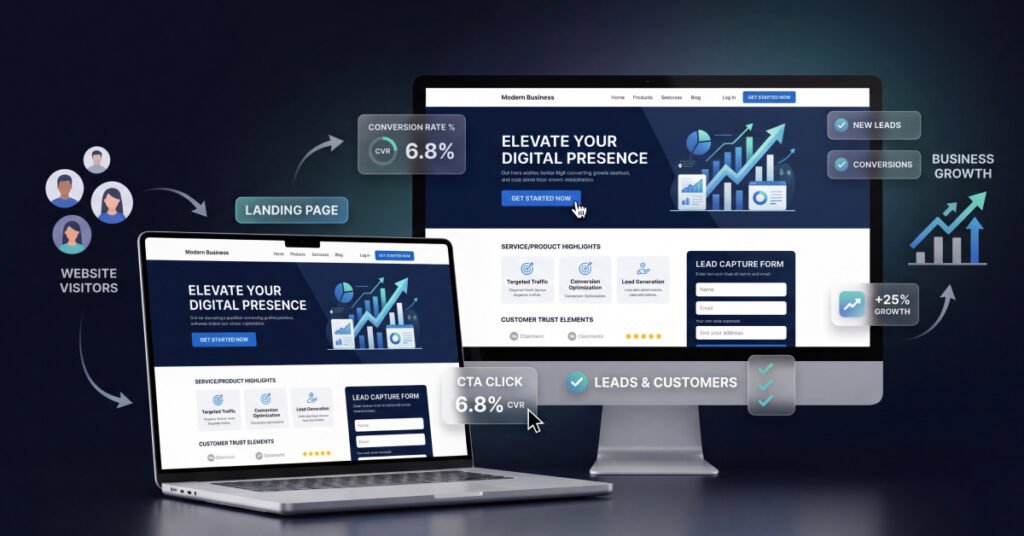
Advertisers spend enormous amounts of attention on campaign structure, bidding strategy, and keyword selection. The landing page the page the user arrives at after clicking receives a fraction of that attention, despite being the single factor most responsible for whether a click converts.

The alignment between ad copy and landing page content is non negotiable. When your ad says “Free PPC Audit for Small Businesses in Indiana,” the landing page headline needs to say something very close to that. Not the homepage of your agency website. Not a generic “contact us” page. The specific landing page for the specific offer in the specific ad with the headline, the CTA, and the supporting content all aligned with what the user expected when they clicked.
What This All Comes Down To
Google Ads in 2026 rewards specificity. Specific keywords matched to specific ads matched to specific landing pages. Specific audience signals that give Smart Bidding accurate data. Specific conversion actions that represent actual business outcomes. Specific testing protocols that generate learnings rather than noise.
The businesses getting the best PPC performance are not the ones with the biggest budgets. They are the ones who built the right foundations conversion tracking, campaign structure, landing page alignment and then used automation as a multiplier rather than a substitute for strategic thinking.
Every piece of this guide is actionable. Quality Score improvement, negative keyword management, Smart Bidding strategy, Performance Max architecture, conversion tracking setup none of it is theoretical. All of it produces measurable changes in CPC, conversion rate, and ROAS when executed consistently.
If your Google Ads campaigns are spending without producing the results your business needs, the answer is almost always one of the issues covered above: A structural problem, a tracking problem, an alignment problem, or a bidding problem. Identify which one or which combination and fix it systematically.
Ready to build Google Ads campaigns that actually move the needle? Talk to Infiniteville’s PPC Team Today