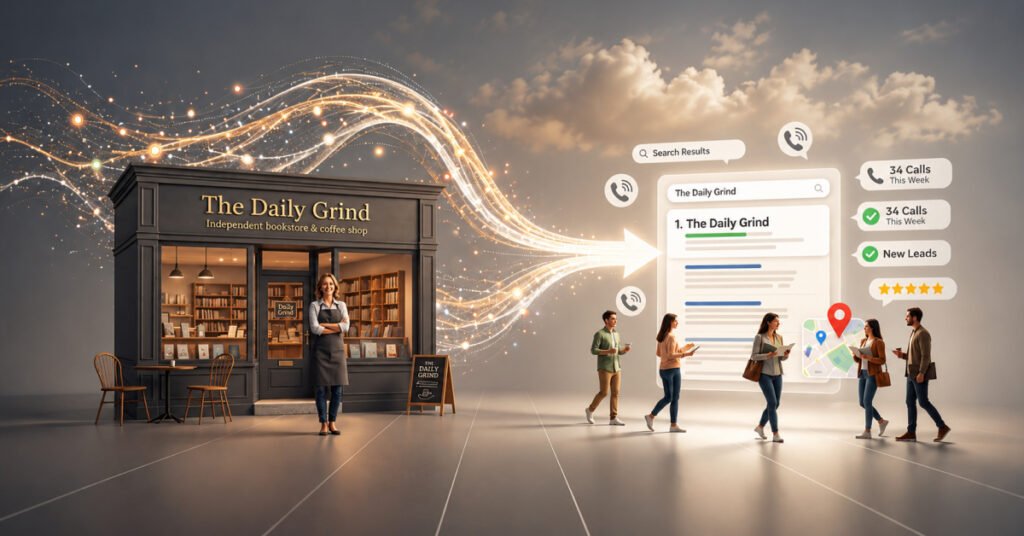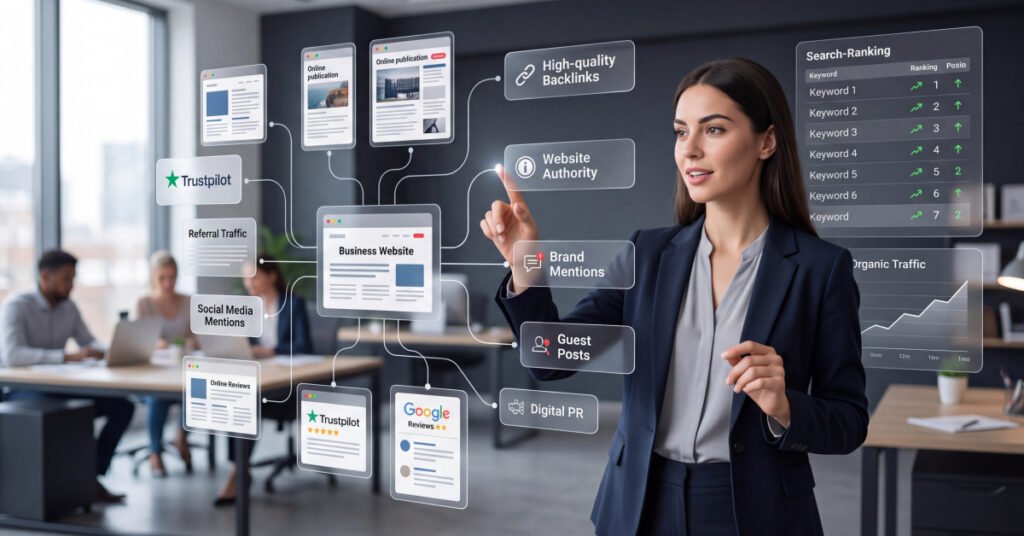
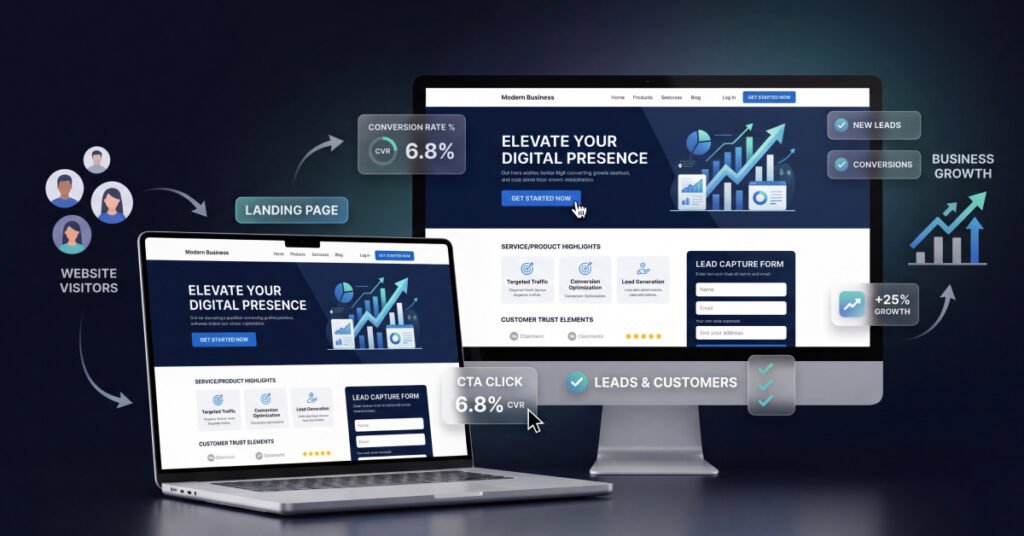
A landing page is a standalone web page built around a single conversion goal. A visitor arrives from an ad, email, or search result, sees one clear message, and takes one specific action: filling in a form, booking a call, downloading a resource, or making a purchase. Every element on the page exists to support that single action. Navigation menus, unrelated links, and competing offers are removed because each additional option reduces the probability that the visitor converts.
That is what separates a landing page from every other page on your website. Your homepage introduces your brand and lets visitors explore wherever they choose to go. A landing page does the opposite. It is built for a specific audience, arriving from a specific source, with a specific intent. The tighter that alignment, the higher the conversion rate.
At Infinite Ville, we have built and optimised landing pages for businesses across B2B, eCommerce, healthcare, and local services. The businesses that convert more leads from the same traffic are the ones with dedicated, purpose built landing pages behind every campaign, every service, and every offer.
Companies with 40 or more landing pages generate 12x more leads than those with five or fewer.
The Two Main Types of Landing Pages
Lead Generation Landing Pages
Lead generation landing pages collect visitor information in exchange for something of value. The visitor completes a short form and receives a free consultation, a quote, a guide, or access to a resource in return. This type works best for service businesses and B2B companies where the sale happens through a conversation rather than a direct purchase. The page presents the offer, explains the value, reduces friction in the form, and places trust signals where hesitation is highest. Every field beyond what is strictly necessary reduces completion rates. Three to five fields produce the highest volume of qualified leads for most contexts.
Click Through Landing Pages
Click-through landing pages use no form. A single CTA button takes the visitor directly to a purchase, booking, or checkout page. eCommerce brands and SaaS companies use this format to address objections and build confidence before asking for a transaction. The page warms the visitor up so that by the time they reach the checkout, the decision is already made. This format works particularly well for retargeting campaigns and warm audiences who are close to buying but need one final push.
Homepage vs Landing Page: The Full Difference
Most businesses send campaign traffic to their homepage by default. This is one of the most common conversion mistakes in digital marketing. A homepage is built for exploration. A landing page is built for commitment. The table below shows exactly how they differ across every relevant dimension.
| Factor | Homepage | Landing Page |
| Purpose | Introduce the brand and provide navigation to all areas of the site | Convert a specific visitor from a specific source with a single offer |
| Audience | Everyone, from first time visitors to returning customers | One defined audience segment arriving from one specific campaign or source |
| Navigation menu | Yes, full site navigation with links to all pages | No navigation. Every link that is not a CTA is removed |
| Number of goals | Multiple: explore services, read blog posts, find contact details, learn about the brand | One goal only. Every element on the page supports a single conversion action |
| CTAs | Several, often generic: Learn More, Contact Us, Explore Services | One primary CTA, repeated at multiple scroll points, specific to the offer |
| Traffic source | Direct visits, branded search, organic discovery, returning visitors | Paid ads, email campaigns, social media posts, specific organic search terms |
| Conversion role | Awareness and orientation, not primarily conversion | Conversion. The entire page is designed to produce one measurable outcome |
| Content depth | Broad, covering many services, company information, and resources | Focused exclusively on the offer, the audience’s specific pain point, and the solution |
The core principle is message match: the visitor who clicked your ad or email arrives expecting to find exactly what was promised. When the landing page delivers that promise with the same language and the same offer, trust remains intact and conversion follows. When the homepage presents a different experience, visitors leave before taking any action.
Sending paid traffic to your homepage and losing conversions?
Infinite Ville designs and builds conversion focused landing pages for businesses running paid media, SEO campaigns, and email marketing. We build pages that match your campaign message and convert the traffic you are already paying for.
Why Every Business Needs a Landing Page
Reason 1: Your Campaigns Need a Dedicated Destination
Every marketing campaign sends traffic somewhere. Where that traffic lands determines whether your spend produces leads or disappears into a website that was never designed to convert that specific visitor. A dedicated landing page matches the ad’s message precisely. When the promise in the ad and the content of the page are aligned, visitors follow through. When they are not, visitors leave immediately, and you pay for traffic that produces nothing.
Reason 2: Landing Pages Improve Ad Campaign Efficiency
Google Ads Quality Score includes landing page experience as one of its three primary components. A page that matches the ad keyword, loads quickly, and presents a clear and relevant offer earns a higher Quality Score. A higher score means lower cost per click and better ad positions for the same daily budget. Poor landing pages directly inflate ad costs. Fixing the page rather than the ad copy often produces the fastest improvement in paid campaign return on ad spend.

Reason 3: They Convert More Traffic Without Increasing Spend
If your website receives 500 monthly visitors at a 1% conversion rate, you get 5 leads. A dedicated landing page converting at 4% produces 20 leads from the exact same traffic. Landing page optimisation multiplies the return from every existing traffic source without increasing your marketing budget. The average landing page converts at 2.35%. The top 25% convert at 5.31% or higher. That gap is not luck. It reflects specific structural and copy decisions that are learnable and replicable.
Reason 4: They Qualify Leads Before Anyone Picks Up the Phone
A well structured landing page does qualification work automatically. The headline, offer description, and form communicate specifically who the page is for. Visitors who are not the right fit self-select out without completing the form. For B2B businesses, a qualifying question in the form, such as company size or specific business goal, ensures that leads entering the pipeline have already indicated fit before any sales conversation begins. That improves close rates and reduces wasted time on both sides.
Why AI-Powered SEO For Small Businesses Matters
Reason 5: They Build Trust at the Exact Moment a Visitor Decides
Landing pages are where conversion decisions happen. A visitor who clicked your ad is already interested. What they need in the next 30 seconds is enough trust to act. That trust comes from specific, visible signals: named testimonials with verifiable outcomes, case study results with real numbers, security badges near form fields, and a clear statement of what happens after submission. Generic claims carry little weight in 2026. One specific testimonial from a named client with a measurable result converts better than five unattributed five star ratings.
Reason 6: They Give You Clean, Attributable Data for Every Campaign
A dedicated landing page per campaign produces clean, attributable conversion data. You know exactly how many visitors arrived, where they came from, where they dropped off, and how many converted. When all campaigns point to the same homepage, those signals mix and become unreadable. Clean data is also the foundation for A/B testing: running two page variants simultaneously to determine which headline, CTA, or form structure produces a higher conversion rate. Over successive test cycles, conversion rates compound upward from the same fixed traffic.
Reason 7: They Expand Your Organic Search Visibility
Dedicated landing pages for specific services, locations, or use cases give search engines more pages to evaluate and rank. A business with ten service-specific and location specific landing pages competes for ten distinct keyword sets, multiplying its potential organic visibility. For local businesses, location pages targeting city and service combinations are the primary mechanism for ranking in those specific markets. Without dedicated pages, organic search visibility in those locations is structurally limited regardless of domain authority.
What Every High-Converting Landing Page Includes
The structure of a high performing landing page is consistent across industries and offer types. The specific content changes. These elements do not.
– A headline above the fold that matches the ad or link the visitor clicked and states the core offer immediately.
– A subheadline that addresses the primary objection or clarifies what the visitor receives.
– Social proof near the top: a specific client quote with a name and outcome, or a recognisable client logo strip.
– A benefit oriented description of the offer written around what the visitor gains, not what the business provides.
– A short form with a maximum of five fields and a submit button that restates the offer rather than using generic text like Submit or Click Here.
– Trust signals near the form: privacy statements, security badges, or a brief client result.
– A single primary CTA repeated at minimum twice: once above the fold and once at the close of the page.
– No navigation menu. Every link that does not lead to the conversion action is a potential exit point.
– A page that loads under two seconds on mobile. Research from Unbounce confirms that 53% of mobile visitors abandon pages that take longer than three seconds to load.

The Most Common Landing Page Mistakes
Multiple offers on one page. Pages with more than one offer reduce conversion rates by up to 266% according to a Wishpond study. One page, one goal.
– Keeping the site navigation on a campaign landing page. Every nav link is an exit route for a visitor who has not yet converted.
– Generic CTA text. Submit and Learn More communicate nothing about what the visitor gets. Use specific, action-led language: Get My Free Audit or Book My Strategy Call.
– Forms with too many fields. Every field beyond what you immediately need costs you completions. Start with name, email, and phone.
– No social proof near the form. The highest anxiety point on any page is the moment before a visitor submits their information. Trust signals placed directly beside the form reduce abandonment at that exact moment.
– Sending every campaign to the same page. Different audiences, offers, and traffic sources need different pages with different messaging.
Already running campaigns but your pages are not converting?
Infinite Ville audits your existing landing pages against conversion best practices and identifies the specific structural, copy, and design changes that will produce the largest improvement in lead volume.
A Landing Page Is Not a Luxury. It Is the Minimum.
Every campaign you run deserves a destination built to convert that specific campaign’s traffic. Sending paid traffic to a homepage, asking email subscribers to navigate a full website, or directing social media clicks to a generic services page produces weaker results from the same budget. Dedicated landing pages solve that problem by meeting each visitor exactly where they are, with exactly the message they arrived expecting.
The compounding effect of landing page testing also means that the pages you build now get better over time. A page that converts at 2% in month one can convert at 5% by month six through consistent measurement and testing, without changing the traffic source or the offer. That improvement happens at zero additional cost per lead.
At Infinite Ville, every landing page we build comes with conversion tracking, heatmap integration, and a structured testing plan. We do not consider a page complete at launch. We consider it ready for the first round of evidence.
Ready to build landing pages that actually convert your traffic?
Infinite Ville designs, builds, and continuously optimises landing pages for businesses that want more leads from every campaign they run. From initial design through A/B testing and performance tracking, we handle the full process. The consultation is free click here.
Frequently Asked Questions
What is a landing page?
A landing page is a standalone web page built for one specific conversion goal. It has no navigation menu and presents a single offer to visitors arriving from a specific ad, email, or link. Every element on the page exists to move that visitor toward one action.
What is the difference between a landing page and a homepage?
A homepage introduces your brand and serves visitors at every stage of awareness with full navigation and multiple CTAs. A landing page removes all navigation, focuses on one audience, and drives one specific action. Homepages are for exploration. Landing pages are for conversion.
Why do landing pages convert better than homepages?
Because they are built for one visitor type with one intent. A homepage asks visitors to find their own way. A landing page removes every distraction and points everything at a single action, which reduces friction and increases the probability that the visitor follows through.
How many form fields should a landing page have?
Three to five fields produce the highest volume of qualified leads for most contexts. Every field beyond the minimum required reduces form completion rates. Start with name, email, and phone number, and add qualifying questions only once conversion volume is strong enough to allow it.