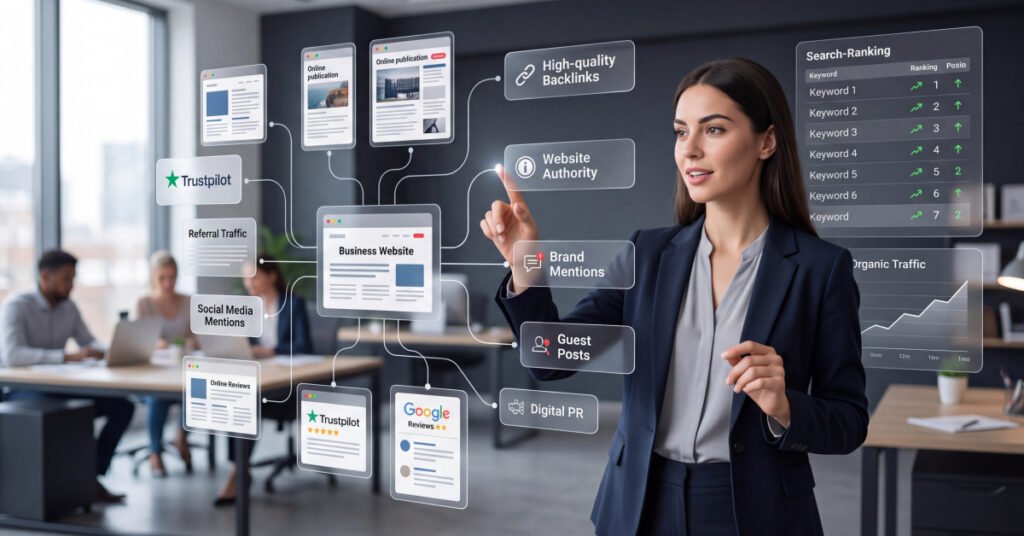
On page SEO tells search engines what your site is about. Off page SEO tells them whether your site deserves to rank. Every backlink, brand mention, review, and editorial citation from outside your domain functions as a vote of confidence, and Google weighs those votes when deciding which pages earn the top positions for competitive queries.
This guide covers every major off page signal that matters in 2026, what each one does, why it works, and the specific actions you can take to build them. The team at Infinite Ville has applied these strategies across 95+ client campaigns spanning B2B, eCommerce, healthcare, and local services. The tactics below are what consistently produce measurable ranking improvements.
Why Off Page SEO Carries More Weight Than Most Businesses Realise
Search engines use on page content to understand what you offer. They use off-page signals to determine whether you are a trustworthy, authoritative source in your space. When two pages have similar content quality and technical foundations, off-page authority is typically the deciding factor.
A few strong backlinks outperform hundreds of weak ones:
Google’s Andrey Lipattsev confirmed in a 2016 live Q&A that links remain one of the top three ranking signals. In 2026, with AI systems now evaluating entity authority across the full web, that signal has only grown in complexity. Quality and topical relevance now matter more than volume.
In 2026, off-page SEO covers a broader set of signals than it did five years ago. Search engines now analyse brand mentions without hyperlinks, entity presence across the Knowledge Graph, social signals, review profiles, podcast appearances, and editorial citations in AI-generated answers. Building off-page authority means building a credible digital reputation across all of these surfaces.
Want to see where your off page authority stands right now?
Infinite Ville runs a full backlink and brand authority audit showing you your current domain authority, link gap against competitors, and the specific off-page actions that will move your rankings fastest.
The Core Off Page Signals That Drive Rankings in 2026
1. Backlink Quality and Topical Relevance
Backlinks remain the most direct off-page ranking signal. A link from an authoritative, relevant domain passes link equity (sometimes called link juice) to your site, increasing your domain authority and improving ranking potential across your keyword targets.
The critical shift in 2026 is that relevance now matters as much as domain authority. A link from a mid-authority site in your exact niche sends a stronger topical relevance signal to Google than a link from a high-DA site with no connection to your subject matter. Build links from sites your target audience actually reads.
Anchor text diversity is equally important. A natural backlink profile includes branded anchors, generic anchors, partial match anchors, and exact match anchors in proportions that reflect genuine editorial citation patterns. Profiles dominated by exact match anchor text trigger algorithmic scrutiny.
2. Brand Mentions and Unlinked Citations
Google can identify your brand name as an entity using Natural Language Processing and entity recognition, even when no hyperlink accompanies the mention. Unlinked brand mentions on authoritative sites contribute to your entity presence in the Knowledge Graph and signal to search engines that your brand is talked about in your space.
Monitor brand mentions using tools like Ahrefs, SEMrush, or Google Alerts. When you find unlinked mentions on high-authority domains, reach out and request a link. Converting unlinked mentions to linked citations is one of the fastest ways to build backlinks from domains that are already predisposed to reference you.
3. Digital PR and Earned Media
Digital PR campaigns generate editorial links from news sites, industry publications, and authoritative blogs by creating content that journalists want to cover. This includes original research, proprietary data reports, expert commentary on breaking industry news, and unique studies that produce citable statistics.
A single piece of original research placed in a respected industry publication can earn dozens of editorial backlinks as other sites pick up and cite the data. This is the most scalable way to build high-authority links at volume without crossing into tactics that violate Google’s guidelines.
4. Guest Publishing on Authoritative Sites
Guest articles on reputable sites in your niche build backlinks, demonstrate expertise, and expand brand visibility simultaneously. The key distinction between effective guest publishing and low-value link schemes is the quality of the host site. Target publications with genuine editorial standards, real audiences, and organic traffic. Sites that exist purely to host guest content provide minimal SEO value and carry penalty risk.
When writing guest content, focus on delivering genuine value to the host site’s audience. Include a natural contextual link back to a relevant resource on your site, not just your homepage, and ensure the anchor text reads naturally within the sentence.
5. E-E-A-T Signals Across the Web
Google’s Experience, Expertise, Authoritativeness, and Trustworthiness framework evaluates your brand and its contributors across the entire web, not just your own site. Author profiles on LinkedIn, published research papers, industry conference appearances, podcast guest slots, and mentions in industry roundups all feed into how Google’s systems assess the expertise behind your brand.
Why You Need Technical SEO Audit Service – Losing Traffic
Building named expert profiles for your key team members creates what Google calls author entities: verifiable individuals with real credentials whose output Google can evaluate for quality. When your team members publish bylined content on third party sites, that off site expertise reinforces the E-E-A-T signals on your own pages.

6. Online Reviews and Reputation Signals
Review profiles on Google Business Profile, G2, Trustpilot, Yelp, and industry specific platforms contribute to your brand’s trust and local ranking signals. Google uses review velocity (how often new reviews arrive), review sentiment, and keyword usage within reviews as signals when evaluating brand credibility.
7. Local Citations and NAP Consistency
For businesses serving specific geographic areas, consistent NAP (name, address, phone number) citations across directories, local business sites, and regional publications directly influence map pack rankings and local organic visibility. Inconsistent NAP data across platforms creates conflicting entity signals that suppress local rankings.
Audit your NAP data across all major directories including Google Business Profile, Bing Places, Yelp, Yellow Pages, and industry specific directories. Correct any inconsistencies before building new citations. A clean, consistent citation profile tells search engines exactly who you are and where you operate.
8. Social Signals and Platform Authority
Social media shares and engagement are not direct ranking factors, as google has confirmed. Their indirect impact, however, is significant. Content that performs well on social media reaches more eyeballs, which increases the probability that a journalist, blogger, or site owner will see it and link to it. High engagement content on LinkedIn, X, and industry specific communities generates natural editorial links that carry genuine authority.
9. Podcast Appearances and Audio Content
Guest appearances on respected podcasts in your niche generate backlinks from show notes, build brand awareness with targeted audiences, and create author entity signals that strengthen off-page authority. Many podcast hosts publish companion blog posts and resource pages that link to guest speakers, creating editorial citations alongside the audio content.
Prioritise podcasts with genuine listenership and strong domain authority on their host sites. A guest slot on a well regarded industry podcast can produce three to five strong backlinks from a single appearance while positioning your team as recognised experts in the space.
10. AI Share of Voice and GEO Signals
In 2026, a new off page signal has emerged: how often AI systems cite your brand in generated answers. When ChatGPT, Perplexity, and Google AI Overviews consistently cite your content when answering questions in your category, it builds AI Share of Voice. This signal feeds back into traditional authority metrics because being cited by AI systems correlates with editorial credibility.
Building AI Share of Voice requires the same foundations as traditional off-page authority: high-quality content, strong backlink profiles, credentialed authors, and structured data. It also requires direct content optimisation for AI retrieval, including FAQ schema, direct answer blocks, and comprehensive topical coverage.
Building off-page authority is a long game. We make it a systematic one:
Infinite Ville builds integrated off-page strategies covering link acquisition, digital PR, brand mention monitoring, and AI citation optimisation. Every tactic maps to a revenue outcome, not a vanity metric.

How to Audit Your Current Off-Page Performance
Before building new off-page signals, document your baseline. Open Ahrefs or SEMrush and run a backlink audit on your domain. Record your current Domain Rating or Domain Authority, your total number of referring domains, the ratio of dofollow to nofollow links, your top linked pages, and the authority spread of your linking sites.
Run the same audit on your top three competitors. The gap between their referring domain count and yours shows you how much link acquisition work is ahead. The quality of their linking domains tells you which sites to target first. Closing the authority gap with your strongest competitor is the most direct path to outranking them on shared keywords.
Check your disavow file if you have one. Links from gambling sites, adult content farms, and private blog networks with artificially inflated domain authority can trigger algorithmic penalties. If your rankings dropped after a Google core update and you have never audited your link profile for toxic links, start there. Google Search Console shows all links pointing to your site, and the disavow tool lets you flag those you want Google to ignore.
Common Off Page SEO Mistakes That Suppress Rankings
Building links from sites with no organic traffic: A site with high domain authority but zero visitors provides a technical link signal but no editorial credibility. Check organic traffic in ahrefs before targeting any site.
Using exact match anchor text too aggressively: A profile where the majority of anchors repeat your target keyword reads as manipulative to google’s systems. Vary your anchor text naturally.
Neglecting brand mention monitoring: Unlinked citations are free backlink opportunities. Most businesses ignore them entirely. Set up google alerts and ahrefs mentions tracking for your brand name.
Ignoring review velocity: A Google Business Profile with 40 reviews and no new ones in 12 months signals stagnation. Fresh reviews with specific keyword mentions strengthen both local rankings and entity trust.
Treating social media as separate from SEO: Your LinkedIn content, podcast episodes, and industry forum contributions all generate potential link sources. Treat them as top of funnel link acquisition channels.
Skipping the disavow audit: A toxic link profile compounds over time. One google core update can expose links that have been silently suppressing your rankings for months.
Off-Page SEO Is a Long Term Asset, Not a Short Term Tactic
The businesses that consistently rank at the top of competitive search results are not the ones that published the most content last quarter. They are the ones that built the most credible off-page presence over time. Backlink authority, brand recognition, editorial citations, and entity presence compound across months and years in a way that paid media spend cannot replicate.
Start with a clean baseline audit. Identify your link gap against your top competitors. Build a content-led link acquisition strategy around original research and digital PR. Monitor brand mentions and convert unlinked citations to links. Build expert author profiles for your team. Maintain a clean NAP citation profile if you serve local markets.
These actions, applied consistently, produce ranking improvements that no single quick fix can match. At Infinite Ville, every off-page campaign we build starts with this framework and scales based on the competitive demands of your specific market.
Ready to build off page authority that actually moves rankings?
We audit your current link profile, identify your authority gaps, and build a campaign that targets the exact domains and placements your competitors are getting links from. The audit is free. The plan is specific to your site.