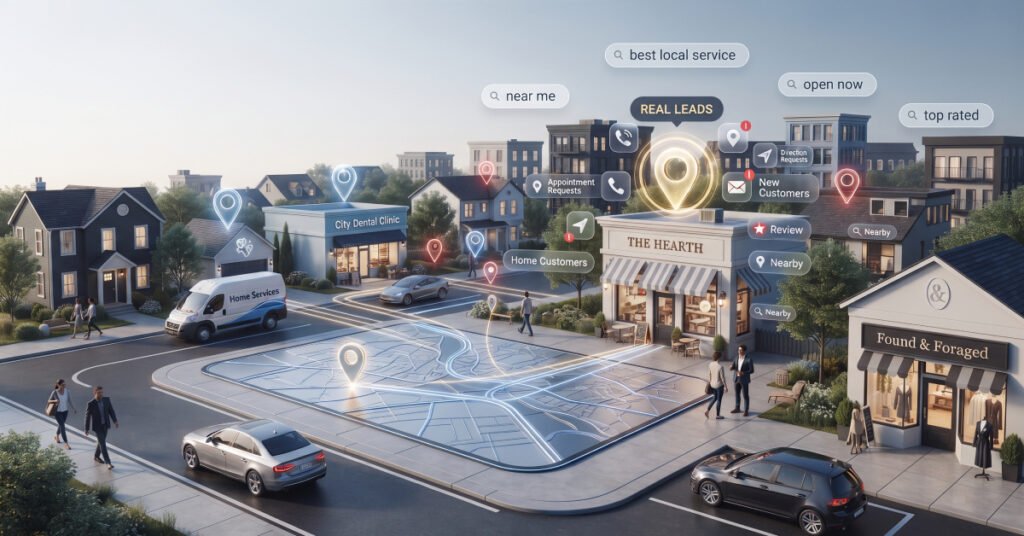
Local SEO generates more leads for your business by making it appear in front of buyers who are already searching for your services in your area. When someone searches ‘HVAC repair near me’ or ‘digital marketing agency South Bend,’ Google returns a map pack of three local businesses and a set of organic results beneath it. Appearing in either of those positions means that buyer finds you before they find a competitor. Not appearing means the lead goes elsewhere.
The leads that come from local search are among the highest-converting of any marketing channel. According to Google’s own research, 76% of people who search for something nearby on their smartphone visit a related business within 24 hours, and 28% of those searches result in a purchase. These are buyers with specific intent who are ready to act, and local SEO puts your business in front of them at the exact moment they are looking.
At Infinite Ville, we have run local SEO campaigns for home service businesses, healthcare providers, legal firms, and professional services companies across the US. The strategies below are what consistently produce the highest lead volume from local search.
76% of people who perform a local search on a smartphone visit a business within 24 hours.
Why Local SEO Is Different from General SEO
General SEO focuses on ranking for keywords across any geography. Local SEO focuses specifically on ranking for searches within a defined area, appearing in the Google map pack, and converting that visibility into phone calls, form submissions, and walk-ins. The ranking signals are different, the content strategy is different, and the technical requirements are different.
Google evaluates local search results using three primary signals: relevance (how closely your business matches what the user searched for), distance (how close your business is to the user or the location mentioned in the search), and prominence (how well known and reputable your business is based on links, reviews, and citations). Optimising for all three simultaneously is what gets a local business into the map pack and keeps it there.
In 2026, AI Overviews now appear in local search results on mobile, often pulling business information directly from Google Business Profiles and local content pages. Businesses that optimise their GBP and local landing pages for structured data appear in these AI-generated summaries, which have become a significant lead source alongside the traditional map pack.
Not showing up when local buyers search for your services?
Infinite Ville runs local SEO campaigns for businesses across the US. We audit your current local visibility, identify exactly where competitors are outranking you, and build a plan that gets your business into the map pack and onto the first page of local organic results.
Book Your Free Local SEO Audit
Eight Strategies That Generate More Local Leads Through SEO
1: Fully Optimise Your Google Business Profile
Your Google Business Profile is the single most important asset in local SEO. It is what powers your map pack listing, your knowledge panel, your appearance in google Maps, and increasingly your visibility in AI Overviews on mobile. An incomplete or neglected GBP costs you leads every day, because google uses profile completeness and activity as ranking signals.
Complete every section without exception business name, address, phone number, website, hours, service categories (primary and secondary), service areas, and business description. Upload at least 20 high-quality photos including interior, exterior, team, and work examples. Post updates at least twice per week because google treats posting frequency as an activity signal. Add your full service list with individual descriptions. Enable messaging so mobile users can contact you directly from Maps without visiting your website.
Respond to every review, positive or negative, within 24 hours. Review responses are visible to every prospective customer who reads your profile and signal to google that you are actively managing the listing. Businesses that respond to reviews consistently rank higher in the local pack than those that do not.
2: Build NAP Consistency Across Every Directory
NAP stands for name, address, and phone number. Google cross-references your business information across dozens of directories, review sites, and local platforms to verify that you are a real business operating at a real location. When your name appears as ‘Infinite Ville’ on your website but ‘InfiniteVille LLC’ on Yelp and ‘Infinite Ville Marketing’ on Bing Places, Google registers those as conflicting signals. Conflicting NAP data directly suppresses local rankings.
Local Business SEO Services for Indiana: The Complete Guide to Dominating Your Local Market in 2026
Audit your current citations using tools like BrightLocal or Whitespark. Export every instance of your business listing across the web and identify inconsistencies in name format, address format (Suite vs Ste, Street vs St), and phone number format. Correct every inconsistency before building new citations. A clean, consistent NAP profile across Google Business Profile, Bing Places, Apple Maps, Yelp, Facebook, the Better Business Bureau, and industry specific directories tells search engines exactly who you are and where you operate.
3: Create Location Specific Landing Pages
If your business serves multiple cities, towns, or neighbourhoods, each service area needs its own dedicated page. A single ‘Contact’ page listing all your service areas does not generate local search visibility for those areas. Google ranks pages, not businesses. A page specifically optimised for ‘web design services Indianapolis’ can rank for that query in a way that your homepage never will.
Each location page needs to include the city name and primary service in the H1 and title tag, the specific service description tailored to that market, local references such as landmarks, local statistics, or area-specific context, NAP information for that location if you have a physical presence there, local testimonials from customers in that area, and a clear CTA with a location-specific phone number or booking link. Pages that read as genuine local resources, rather than templated content with the city name swapped in, consistently outperform generic location pages in both rankings and conversion rate.

4: Target Local and Long Tail Keywords
The keywords that drive local leads are not always the most obvious ones. ‘Plumber’ is too broad and too competitive. ‘Emergency plumber South Bend Indiana’ is more specific, carries stronger buying intent, and is far easier to rank for. Location modified keywords combined with service specific terms are the highest converting local search queries because they capture buyers who know what they need and know where they need it.
Research local keyword opportunities using Google Search Console (which shows what queries already drive traffic to your site), Google’s autocomplete and People Also Ask features, and tools like Ahrefs or SEMrush. Look specifically for queries that include your city, neighbourhood, zip code, or regional identifier alongside your service terms. Build individual pages or blog content targeting the highest intent variants, and include them naturally throughout your title tags, H1 headings, meta descriptions, and body copy.
5: Generate and Manage Reviews Systematically
Reviews affect local search rankings directly. Google uses review volume, review velocity (how frequently new reviews arrive), average rating, and keyword content within reviews as local ranking signals. A business with 12 reviews has weaker local authority than a business with 180 reviews, even when the rating is the same. And a business that received all 180 reviews in the past three months has stronger recency signals than one whose last review came six months ago.
Build a systematic review generation process send every completed customer a follow up message within 24 to 48 hours of service completion with a direct link to your Google Business Profile review page. Make it one tap. The harder you make the process, the fewer reviews you collect. Train your team to ask verbally at the point of completion. A customer who has just expressed satisfaction is the most likely to leave a review if asked immediately. Target a minimum of five new reviews per month ten or more per month in competitive local markets produces compounding ranking improvements.
6: Build Local Backlinks
Local backlinks from relevant, geographically specific sources are among the strongest signals for local ranking improvement. A link from a local chamber of commerce, a regional news publication, a neighbourhood business association, a local charity you sponsor, or a complementary local business sends a precise topical and geographic relevance signal that generic national links cannot replicate.
Build local links through active participation in the business community sponsoring local events generates editorial mentions and links from event websites partnering with complementary local businesses produces reciprocal referral links; contributing expert commentary to local news sites generates author links from authoritative local domains and creating genuinely useful local resources, such as a neighbourhood business guide or a local market report, attracts natural links from other local sites that reference it.
7: Publish Local SEO Content
Content that targets location specific search queries builds your site’s local authority and captures buyers earlier in their decision process. A roofing company that publishes ‘how to prepare your roof for Indiana winters’ attracts local buyers who are in research mode before they are ready to book a job. That content builds trust and topical authority, and it ranks for long tail local queries that competitors with only service pages never appear for.
Effective local content topics include area specific guides relevant to your service, local case studies featuring identifiable client locations, neighbourhood level service area posts, comparisons of local market conditions, responses to locally trending questions, and content around local events or issues that relate to your industry. Each piece should target a specific local keyword, link to your primary service pages, and include a location specific CTA that makes the next step obvious.
8: Implement Local Business Schema Markup
Local business schema markup is structured data that tells search engines and AI systems exactly who you are, what you do, where you operate, and how to contact you. Properly implemented schema markup helps your business appear in rich results, knowledge panels, and AI-generated local summaries. In 2026, with AI Overviews appearing in local search results on mobile, schema markup has become a primary mechanism for ensuring your business information appears accurately in these AI-generated answers.
Implement local business schema on your homepage and all location pages. Include business name, address, phone number, URL, opening hours, geographic coordinates, service list, accepted payment methods, price range, and aggregate review rating. Validate your implementation using google’s rich results test and schema.org validator before publishing. Errors in schema markup can produce inaccurate data appearing in rich results, which damages both rankings and conversions.
Running a local business but not generating consistent inbound leads from search?
Local SEO systems that get businesses into the map pack, onto the first page of local results, and in front of buyers at the moment they are ready to spend. The audit is free and includes a local competitor analysis showing exactly where you stand.
What a Strong Local SEO Funnel Looks Like
The goal of local SEO is not rankings. Rankings are the mechanism. The goal is leads: phone calls, form submissions, appointment bookings, and walk ins from buyers who found you through search. A well built local seo funnel moves buyers from search intent to contact in as few steps as possible.
- A buyer searches ’emergency plumber near me’ on their smartphone at 9pm.
- Your Google Business Profile appears in the map pack with your phone number, review rating, and a click to call button. They call directly from the listing. You never needed them to visit your website at all.
- Alternatively, they click through to your local landing page. The page loads in under two seconds on mobile. The H1 matches the search term. A phone number appears at the top of the page without scrolling. They call.
- They visit your site from a local blog post you published on a relevant topic. The post ends with a clear CTA specific to that topic. They fill in a three field form.
Each of these conversion paths requires different optimisation work, but all of them depend on the same underlying foundation: accurate GBP data, consistent NAP citations, pages that load fast on mobile, content that matches local search intent, and trust signals including reviews and local authority that make buyers confident enough to reach out.

The Metrics That Tell You Whether Your Local SEO Is Working
Track these data points to measure local seo lead generation performance:
Google Business Profile calls: Google tracks calls directly from your GBP listing. This is the most direct measure of map pack lead generation. A month over month increase signals improving local visibility.
Direction requests: Users who click ‘directions’ in your GBP listing intend to visit your location. Rising direction requests indicate improving map pack prominence.
Local organic traffic in Google Analytics 4: Filter your organic traffic by city, region, or zip code to see how many visitors from your target service area are arriving through search.
Keyword ranking positions for local terms: Track your positions for your highest priority location modified keywords weekly using Ahrefs, semrush, or bright local. Movement in these positions precedes traffic changes by two to four weeks.
Inbound calls and form submissions with source tracking: Ask every new enquiry how they found you, and track source attribution in your CRM. Customers who say ‘I searched google’ are your local seo leads.
Local SEO Is a Compounding Investment
The businesses with the strongest local search presence in 2026 are not those that tried local SEO once and abandoned it when results were slow in month two. They are the ones that built their GBP correctly, cleaned their citations, published consistent local content, and generated reviews systematically over 12 to 24 months. That compound investment builds a local authority that competitors cannot replicate quickly, and it generates leads continuously without a per click cost attached to every enquiry.
Local search traffic converts at a higher rate than almost any other inbound channel because the buyer is already in your market, already searching for your specific service, and already close to a decision. The job of local SEO is simply to make sure your business is visible at that moment. Everything else follows from that visibility.
Our local SEO campaigns start with a full audit of your current visibility, NAP consistency, GBP profile, and competitor positions. We identify the specific gaps that are costing you leads each month and build a phased strategy that closes them systematically.
Ready to build a local search presence that generates consistent leads every month?
Infinite Ville builds and manages local SEO campaigns for businesses across the US. We handle everything from GBP optimisation and citation building to local content and link acquisition. Your audit is free and comes with a clear action plan.
Frequently Asked Questions
What is local SEO and how does it differ from regular SEO?
Local seo focuses specifically on improving your business’s visibility in location based search results, including the google map pack, google Maps, and local organic results for searches that include a geographic modifier or a ‘near me’ qualifier. Regular seo aims to rank for keywords across any geography. The ranking signals differ, local seo emphasises google business profile optimisation, NAP citation consistency, local reviews, and geographic relevance, while general seo emphasises domain authority, content quality, and backlink profiles. Both disciplines share technical foundations, but the optimisation priorities are distinct.
How long does local SEO take to generate leads?
Most businesses see improvement in google business profile visibility within four to eight weeks of a systematic optimisation campaign. Local landing pages and local content typically show ranking movement within 60 to 90 days. Significant, consistent lead volume from local seo develops over three to six months, with compounding improvement over 12 to 18 months as reviews accumulate, local authority builds, and content matures. The fastest improvements typically come from GBP optimisation and NAP cleanup because these address ranking deficiencies that google can evaluate and respond to within weeks rather than months.
What is the Google map pack and how do I get my business into it?
The Google map pack (also called the local pack or local 3-pack) is the set of three business listings that appear at the top of local search results, accompanied by a map. It is the most visible position in local search, appearing above organic results and generating the majority of clicks for local queries. Getting into the map pack requires a fully optimised google business profile with complete information, consistent NAP data across all directories, a strong and growing review profile, local backlinks from geographically relevant sources, and a website with properly implemented Local business schema markup. The three ranking signals google uses for map pack positions are relevance, distance, and prominence.
How important are online reviews for local SEO?
Reviews are one of the most direct local ranking signals Google uses to evaluate businesses for the map pack. Review volume, review velocity (how frequently new reviews arrive), average star rating, and keyword content within reviews all influence local search positions. Beyond rankings, reviews are the primary trust signal that converts a searcher into a caller or visitor. A business with 180 reviews and a 4.7-star rating consistently converts more local searchers than an equally ranked business with 15 reviews, even at the same rating. Building a systematic review generation process is one of the highest return activities in local SEO.