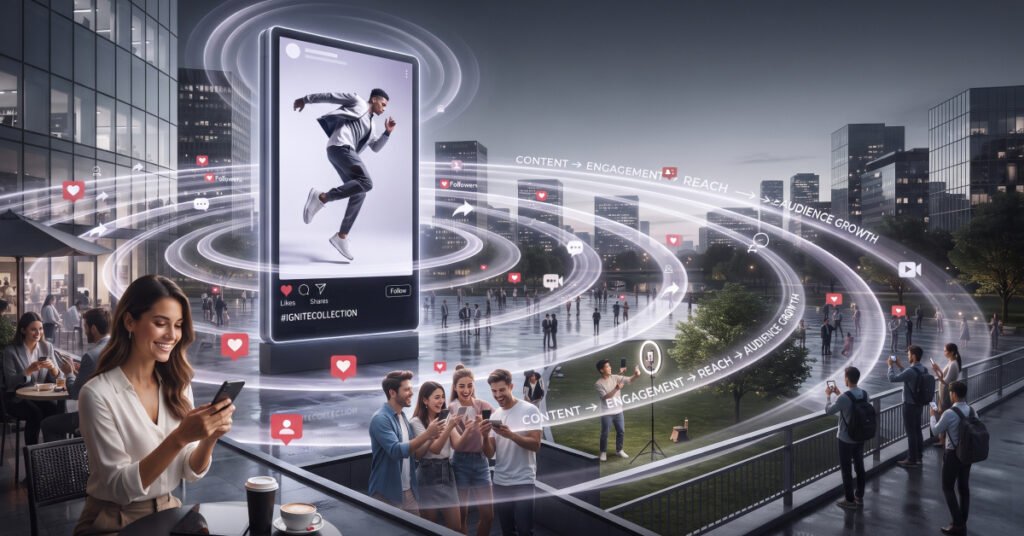
Maximizing your reach on social media in 2026 means producing platform specific content, posting consistently around audience behaviour patterns, combining organic and paid distribution, and building engagement signals that tell algorithms your content is worth amplifying. Posting more does not expand reach. Posting smarter does.
Algorithms across every major platform now prioritise content that generates meaningful interaction over content that reaches a large number of people passively. That shift changes the job of a social media strategy from broadcasting to conversation. The brands growing fastest on social in 2026 treat their channels as two way communication platforms, not bulletin boards.
At Infinite Ville, our social media team manages campaigns across Facebook, Instagram, LinkedIn, TikTok, and YouTube for B2B, eCommerce, and local service businesses. These are the tips that consistently produce the largest reach and engagement improvements across those accounts.
Businesses using structured content calendars achieve 64% more consistent engagement than those posting spontaneously.
Source: Three Girls Media, 2026. Consistency produces compounding results because platform algorithms reward accounts that publish reliably. An account that posts three times per week for twelve weeks builds more algorithmic trust than one that posts fifteen times in a single week then goes quiet.
Understand the Platform Before You Post on It
Every social media platform runs a different algorithm with different ranking signals, different content formats, and a different audience mindset. Content that performs on LinkedIn fails on TikTok. What earns engagement on Instagram gets ignored on X. The most common mistake brands make on social media is treating all platforms as interchangeable and cross posting identical content everywhere.
Facebook’s algorithm in 2026 prioritises content that generates comments, shares, and extended viewing time over posts that collect passive likes. Groups and community content outperform business page posts organically. Facebook remains the most effective platform for local service businesses targeting specific geographic audiences, and its paid advertising ecosystem offers the most precise demographic targeting of any social platform.
Instagram rewards Reels over static posts in terms of reach. The algorithm distributes Reels to non-followers based on engagement rate in the first hour, which means the opening seconds of a video determine whether it reaches a wide audience or stays within your existing follower base. Carousels also outperform single images because they hold attention longer. Stories drive direct engagement and keep your brand visible to followers who do not see your feed posts.
LinkedIn’s algorithm rewards dwell time and comments more than any other signal. A post that generates ten genuine comments within the first two hours gets pushed to a significantly wider audience than a post with fifty likes and no comments. Text posts and document carousels consistently outperform link posts because LinkedIn suppresses content that takes users off the platform. For B2B brands, LinkedIn is the highest converting organic social channel available.
TikTok
TikTok’s For You Page algorithm distributes content to non-followers from the moment of posting, making it the most democratised reach environment of any major platform. Watch completion rate is the dominant ranking signal: if users watch your video to the end and replay it, TikTok pushes it further. The hook, defined as the first two to three seconds, determines whether the algorithm gives your content a second distribution wave.
YouTube
YouTube optimises for click-through rate from thumbnails and titles, and for watch time once users click. A video with a compelling thumbnail and a 70% average view duration outperforms one with mediocre packaging regardless of production quality. YouTube Shorts feed into the same algorithm and serve as a discovery channel that can push users to your long-form content.
Not sure which platforms your audience actually uses?
Infinite Ville builds platform specific social media strategies based on audience data, not assumptions. We identify where your buyers spend their time and build content that fits how each platform works. The consultation is free.

Ten Social Media Marketing Tips That Expand Reach
Tip 1: Build a Content Calendar Around Your Audience’s Behaviour
Posting when your audience is online matters, but posting consistently matters more. Platform algorithms reward accounts that publish on a predictable schedule. A content calendar maps your posting frequency, format mix, and topic rotation across weeks rather than deciding what to post on the day. It also lets you plan content around product launches, seasonal moments, and industry events in advance, which produces higher quality output than reactive posting.
Use your native platform analytics to identify when your current audience is most active. Post your highest effort content in those windows. Schedule evergreen content for the remaining slots. Businesses using structured content calendars achieve 64% more consistent engagement than those posting without a plan, according to Three Girls Media’s 2026 benchmark research.
Tip 2: Lead Every Video with a Strong Hook
Short form video dominates social media reach in 2026 across every major platform. The hook, the opening two to three seconds of any video, is the single most important creative decision you make. Platform algorithms measure how many users continue watching past the three-second mark. A high three second view rate triggers wider distribution. A low one results in the algorithm pulling back reach almost immediately.
Effective hooks create a specific expectation or tension that the rest of the video resolves. They state a counterintuitive fact, ask a question the viewer wants answered, or show the result of something before explaining how it happened. Avoid opening with branding, logos, or slow-paced scene setting. Get to the point in the first second.
Tip 3: Create Platform Specific Versions of Your Content
A single piece of content almost never performs equally across platforms. A 10 minute YouTube video that performs well on YouTube will not work on TikTok. A LinkedIn document carousel will not translate to Instagram Stories. The principle of repurposing content is sound: take the core idea and adapt the format, length, and framing for each platform individually. That is different from simply cross posting the same file with the same caption everywhere.
A practical framework: start with your most substantive content format, typically a long form video, a blog post, or a webinar. Extract key insights and reformat them for each platform. One long form video can produce three TikTok hooks, a LinkedIn text post, two Instagram carousels, and five X posts from the same source material.
Tip 4: Prioritise Engagement in the First Hour After Posting
Most platform algorithms measure the engagement rate of a post in its first hour to determine whether to push it to a wider audience. If you post and then leave the platform, you miss the window when engagement has the highest algorithmic impact. Spend 15 to 20 minutes after posting responding to every comment, asking follow up questions, and engaging with accounts in your niche. This behaviour signals to the algorithm that your content is generating active conversation, which increases distribution.
Reply to comments with substantive responses rather than one word acknowledgments. A comment that generates a reply which generates another reply produces a thread, and threads produce significantly more dwell time on your post than single level comments.
Tip 5: Use User Generated Content to Build Trust at Scale
User-generated content, commonly referred to as UGC, is content created by your customers about your product or service. Reviews, unboxing videos, testimonials, and organic mentions from real buyers carry more credibility than any brand produced content because audiences know it is not scripted. On platforms like TikTok and Instagram, UGC outperforms polished branded content in both engagement rate and conversion.
Request UGC actively. Ask customers to share their experience, create a branded hashtag, or run a campaign that incentivises customers to post. Reshare UGC with credit. Platforms reward brands that generate this kind of organic conversation around their content by pushing it to wider audiences.

Tip 6: Combine Organic and Paid Distribution Strategically
Organic reach alone is not sufficient for consistent growth in 2026. Algorithms are more competitive, feeds are more crowded, and attention is more scarce. Paid social amplifies the reach of content that already performs well organically, rather than spending budget on content that has not yet proven its resonance with your existing audience.
The most efficient paid social strategy in 2026 is to identify your top performing organic posts from the past 30 days, promote those posts to cold audiences who share the same demographic and interest profile as your engaged followers, and retarget website visitors and warm audiences separately with content matched to their stage in the buyer journey. Spending paid budget on already proven content reduces creative risk and produces better cost per result than launching untested paid creative from scratch.
Tip 7: Build a Community, Not Just a Follower Count
Platform algorithms in 2026 explicitly devalue passive follower counts and reward active engagement. An account with 5,000 followers and a 6% engagement rate will consistently outperform an account with 50,000 followers and a 0.3% engagement rate in terms of reach, because the algorithm reads the first account as producing content people genuinely care about.
Build community by asking questions in your posts, responding to DMs and comments as a priority, featuring followers and customers in your content, and creating content that acknowledges the specific experiences and challenges your audience faces. Community is what turns an algorithm dependent following into an owned audience that platforms cannot take away from you.
Tip 8: Optimise for Social Search
Social media has become a search engine for younger audiences. Research from LocaliQ (February 2026) shows that over half of social media users plan to spend more time on community driven platforms in 2026, and a growing proportion use TikTok, Instagram, and YouTube as their primary search tool rather than Google. This shift means your captions, video titles, and on screen text need to include the search terms your audience uses on those platforms, not just hashtags.
On TikTok, the search bar autocomplete shows you what users search most frequently in your category. Use those terms in your video captions and spoken audio because TikTok’s algorithm transcribes speech and matches it to search queries. On YouTube, treat every title as an SEO decision: include the primary keyword your target viewer would type to find that content. On Instagram, keyword-rich captions now affect discoverability beyond hashtag performance.
Tip 9: Measure the Metrics That Connect to Revenue
Reach and impressions tell you how many people saw your content. Engagement rate tells you how many of them cared. Click through rate tells you how many acted on it. Conversion rate tells you how many became customers. Most social media reporting stops at reach and engagement, which are the metrics that feel good but do not pay bills.
Set up tracking that follows the user from social post to website visit to lead or purchase. UTM parameters on all links let Google Analytics 4 attribute revenue to specific posts and campaigns. This data tells you which content types, which platforms, and which audience segments produce customers, not just clicks, and lets you allocate budget and effort toward what actually works.
Tip 10: Refresh Your Strategy Every Quarter
Social media algorithms update constantly. Platform behaviour shifts. Audience preferences evolve. A strategy that produced strong results in January may underperform by April if you have not adapted it to new platform changes or tested new formats. Schedule a quarterly content audit: review your top 10 posts by engagement rate, identify the content types and topics that recur among them, and build the next quarter’s calendar around those signals rather than assumptions.
Test one new format or channel per quarter. If you have not tried LinkedIn document carousels, YouTube Shorts, or Instagram broadcast channels, run a 30 day test with a defined success metric. Most platform expansions that produce material reach improvements for our clients start as a 30 day test, not a permanent strategic commitment.
Managing social media across multiple platforms and not seeing the growth you expected?
Infinite Ville manages full social media strategies for businesses that want consistent reach, real engagement, and content that converts. We handle strategy, content creation, scheduling, and reporting. The audit is free. Click here

The Metrics That Tell You Whether Your Strategy Is Working
Not every metric on your platform dashboard tells you something useful. Tracking the right ones prevents you from optimising for numbers that look good in a report but do not reflect real business performance.
Engagement rate: The percentage of people who saw your post and interacted with it. Calculate it as total interactions divided by reach, multiplied by 100. An engagement rate above 3% is strong for most platforms. Below 1% typically signals that content is not resonating with the audience seeing it.
Reach versus impressions: Reach measures unique accounts that saw your content. Impressions measures total views including repeat views from the same account. A high impressions-to-reach ratio means the same people are seeing your content repeatedly, which indicates either strong remarketing performance or, if the content is organic, that you are not reaching new audiences.
Click through rate: The percentage of people who clicked a link in your post or profile. For organic social, a CTR above 1% is a strong signal of commercial intent. This metric directly connects social activity to website traffic and pipeline.
Follower growth rate: How quickly your audience is growing as a percentage of your current following. A steady 2 to 5% monthly growth rate indicates healthy organic discovery. Sudden drops in growth rate often coincide with algorithm changes or posting frequency reductions.
Video completion rate: the percentage of viewers who watch your video to the end. For short form video under 60 seconds, a completion rate above 40% is strong. Above 60% typically triggers additional distribution on TikTok and Instagram Reels.
Reach Follows Relevance, Not Volume
The brands generating the most reach on social media in 2026 are not the ones posting the most often. They are the ones producing content that their specific audience finds genuinely useful, entertaining, or worth sharing. Algorithms are built to surface that content, and they are increasingly accurate at identifying it.
Start with platform understanding. Build a consistent calendar. Lead video content with strong hooks. Engage actively in the first hour after posting. Combine paid amplification with proven organic content. Measure revenue connected metrics rather than vanity numbers. Revisit and adapt the strategy quarterly.
These are not trends that will expire in six months. They reflect how social platforms are fundamentally built to reward content that real audiences engage with. Apply them consistently and reach grows as a natural consequence of producing content people actually want to see.